
Most organizations run on a cost model that's incomplete and disconnected from the business.
Incomplete: tooling covers cloud, leaving AI (the fastest-growing, least visible category), SaaS, invoices, and internal IT as manual work or blind spots.
Disconnected: raw infrastructure cost has no business meaning until mapped to teams, products, and revenue. The numbers arrive in a portal, late, and no one trusts them enough to act on.
StitcherAI owns the cost model. Every source in one schema. Modeled to your organization so the data is meaningful and actionable. Delivered into the workflows where technology-spend decisions happen. Two engines, one cost model.
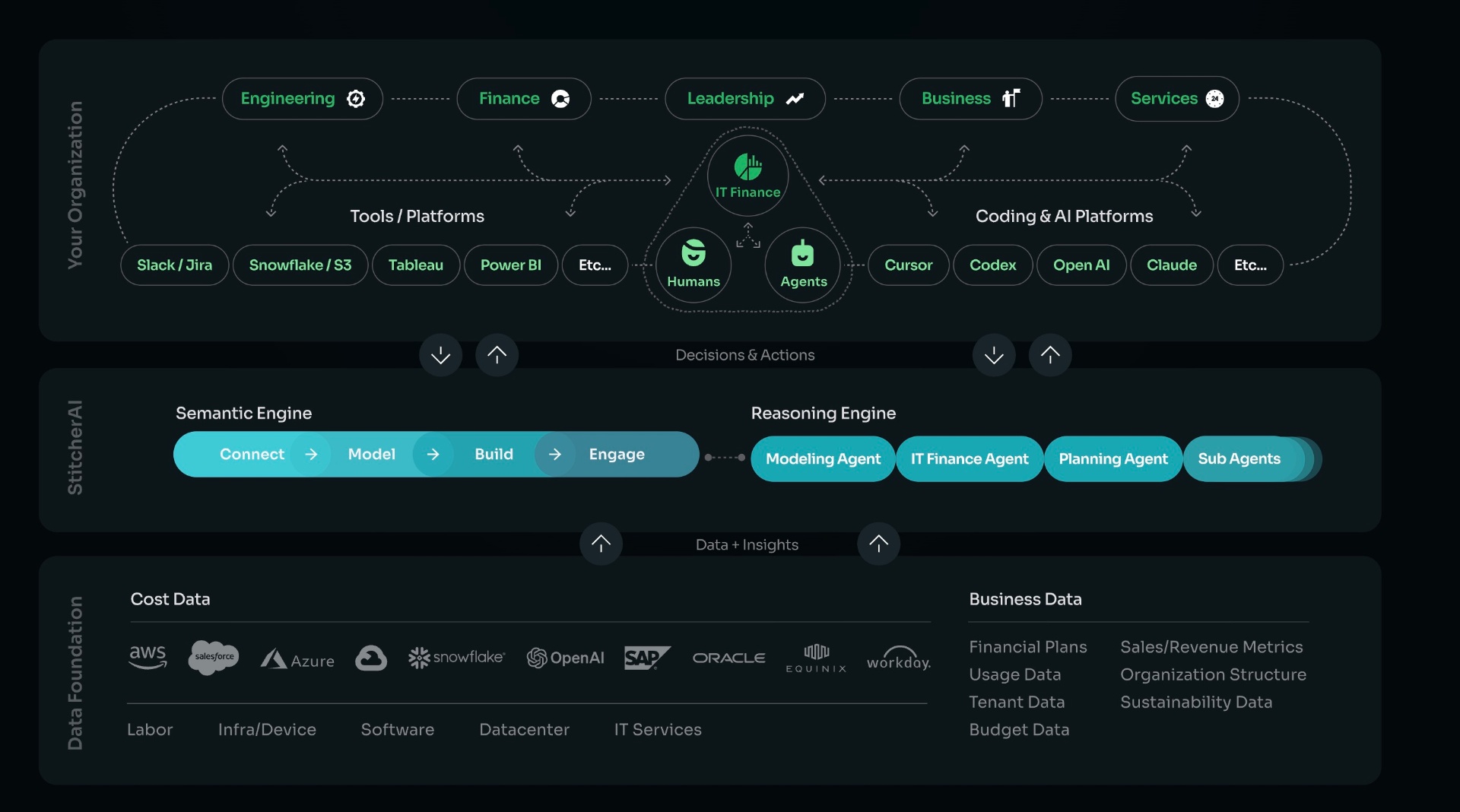
The chart has three bands: your data, scattered across providers and systems; your organization, where decisions get made; and StitcherAI, the layer between, running two engines in parallel: Semantic and Reasoning.
The Semantic Engine
A scheduled pipeline that builds and owns the cost model, in four stages.
Connect brings in cost data (cloud, SaaS, AI, PDF invoices, contracts, internal) and business data from every provider, plus telemetry for AI cost.
Model normalizes every source to FOCUS, then enriches with business context to attribute cost and allocate shared cost to consuming teams. FOCUS (FinOps Open Cost and Usage Specification) is the common language. A Kubernetes export, a SaaS invoice, and a cloud bill all speak it. The result: one model spanning every provider and spend type, every row attributable, every allocation traced to a rule.
Build produces the artifacts you define: KPIs, reports, forecasts, controls.
Engage delivers the modeled dataset and artifacts into your data lakes, Slack, Jira, or BI tools, where stakeholders decide before decisions become irreversible. Outputs: open formats in your storage, your credentials, your environment.
The pipeline is deterministic and reproducible. The whole model is configuration in a version-controlled repository: branchable, peer-reviewed, tagged by period so a past month reproduces exactly. Changing a large cost model feels like shipping software.
The Reasoning Engine
Always-present IT-Finance agents (Modeling, IT Finance, Planning, sub-agents) reason over the model in your AI platforms: Claude, Cursor, Codex. Each plans and executes multi-step tasks with human oversight. The seam between the engines is the whole idea.
One cost model, two engines
Both meet at the cost model: your data connections and the FOCUS schema are the shared contract. The Reasoning Engine reasons over what the Semantic Engine produced: complete, normalized, attributed data. Grounded answers over approximations.
"A cost model must be built correctly and reproducibly: a careful, reviewable, scheduled process. It must also be there at the moment of decision, interactive, inside the workflow."