
The business value of technology rests on a prerequisite most organizations skip: a cost model that is comprehensive, trustworthy, and expressed in the terms the business actually uses. A model like that is what turns a bill into an answer.
But building one starts with a problem that sounds simple and rarely is: assigning every IT dollar spent to the team, product, or service that owns it. This is cost attribution, and it is where most cost models succeed or quietly fail.
Why attribution is the hard part
Attribution assigns every cost to a clear owner, a team, a product, a cost center, so each part of the organization can see what it actually costs to run. That is the foundation everything else stands on. Without it, there is no cost per customer, no margin per feature, no way to say which investments earn their keep.
The difficulty is that most costs do not arrive labeled with their owner.
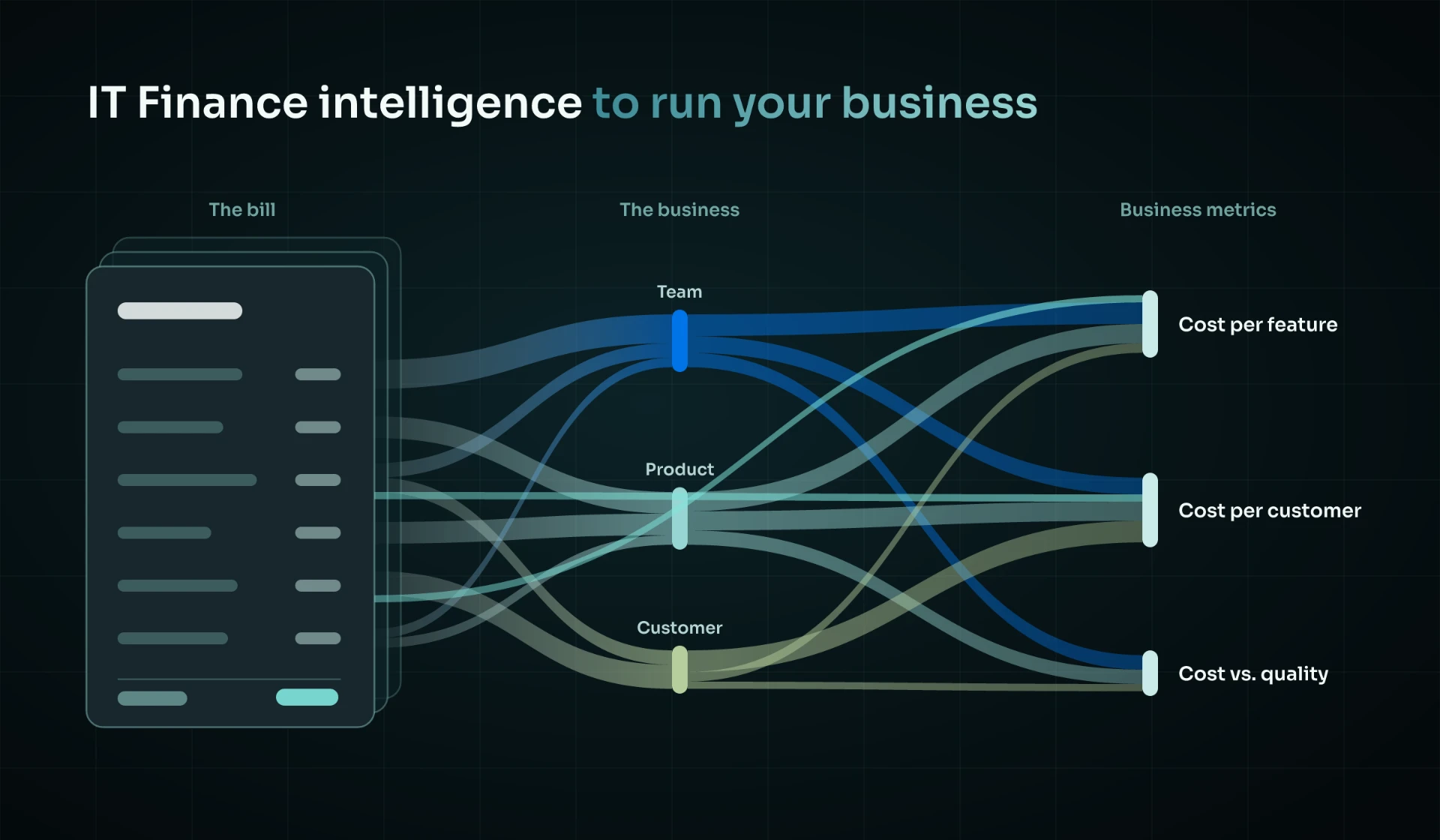
Tags reach only part of the estate. A single application spans compute, storage, SaaS datastores, and inference across multiple providers that no tag set fully captures.
Tags go stale. They are set once and rarely keep pace with a changing organization, leaving a trail of outdated attribution behind as teams, products, and ownership shift.
Most IT spend lives outside the cloud. A SaaS subscription arrives as one organization-wide charge. A vendor invoice is a single line. A data platform is a shared pool consumed by dozens of teams. On-prem and internal costs carry no ownership metadata at all.
None of it comes pre-assigned, and the true owner of a charge depends on how the business is actually organized, which is more complex than any tagging scheme was built to hold.
AI is the hardest case, and the fastest growing
A provider invoice shows tokens consumed and models called, with no link to the teams, features, or customers that drove them. A single agentic workflow can span several providers in one transaction, retry against fallback models, and generate cost through paths no one specified in advance. The bill tells you what was spent and almost nothing about who spent it or why. As more of this spend is initiated by agents acting on their own, the gap between the cost and any human owner widens further.
"Attribution cannot be scraped off the bill. It has to be constructed from the business itself."
The organizations that get this right treat attribution as a deliberate modeling problem, not a one-time labeling exercise. The ones that don't end up with large pools of unowned cost and numbers no one trusts.
Attribution and allocation are not the same
It is worth being precise about where attribution ends. Attribution resolves a cost to the owner responsible for it. Some costs, though, are shared by design: a compute platform or a data lake used across many teams, an authentication service the whole company runs on, security infrastructure a dozen services depend on. These shared infrastructure and services still have an owner, even though the cost belongs to everyone who consumes them. Attribution helps with getting that cost assigned to the respective owners.
Allocation is a distinct step that distributes the cost of shared components across a defined set of receivers, according to an allocation strategy the organization chooses. The two are complementary, and a complete cost model needs both.
Allocation is a deep topic in its own right: how to choose a strategy, which data makes a split fair, and how to keep shared cost from becoming a black box. We will cover it in a subsequent piece. Here, the point is only that attribution and allocation solve different halves of the same problem, and attribution comes first: you cannot fairly distribute what you have not yet attributed.
Attribution requires mapping to the business
Good attribution is rules-based. You are not labeling cost rows one by one; you are writing rules that assign business context to them.
Lookups against ownership data
Often the cleanest way is to join an ownership dataset the organization already maintains. A CMDB, an HR or org-hierarchy export, an application registry: most organizations already track ownership somewhere, and a lookup rule (think spreadsheet lookups) puts that record to work against the cost data. This tends to be the easier path to manage, because the source of truth lives in a system someone already owns and keeps current, and the attribution evolves as that system does.
Pattern-based mappings
When no such record exists, or when you need finer resolution than lookups offer, you write rules that derive ownership from patterns in the cost data itself: an account-name prefix, a tag convention, a naming scheme. These mappings, sometimes called business mappings or virtual tags, are more powerful for granular control, but they are harder to keep correct. They drift as the estate changes, they are easy to get subtly wrong, and they demand ongoing maintenance.
And ownership does not hold still. In a large organization it can change daily, as teams reorganize, services change hands, and products launch and retire. Whichever rules you use, the attribution has to keep pace, or the model quietly falls out of step with the business it is supposed to describe.
So where should you start?
If you are early in the attribution journey, start with a monthly ownership dataset and drive attribution from it.
Cloud: build the ownership data at a high level, equivalent to a FOCUS SubAccount. An AWS account, a GCP project.
SaaS and others: often resource level, equivalent to a Snowflake data warehouse or a Kafka cluster in Confluent.
AI: typically principal level (users and API keys), to which organizational structure data maps directly.
This will cover most of the estate with the least maintenance, and it is the fastest way to get trustworthy numbers in front of people. Then reach for pattern-based rules to fill the gaps that need finer resolution.
If you treat attribution as foundational, as we do, put governance around the spend you have not attributed yet. Track unattributed cost as a metric, and make it trend downward over time. It is the most honest measure there is of how well your attribution is actually working: the smaller that number, the more of your estate carries a real owner. It turns attribution from a one-time project into something you manage and improve.
Unit economics and margins are only as good as attribution
A complete cost model, one that captures every cost source an organization runs on, is what makes the numbers that matter possible. Unit economics like cost per customer and cost per transaction are only as accurate as the attribution beneath them, because each is a cost figure measured against a business figure.
Margins work the same way: a margin is revenue minus cost, so it holds only when the full cost is attributed to the product earning the revenue. In both cases, a missing source flows straight through to the result. Attribute only the cloud portion of a product that also runs on SaaS and AI, and its unit costs read too low and its margins read too high, by exactly the amount left unattributed. Capture every source and attribute it cleanly, and both hold.
Showback, chargeback, budgeting and forecasting improve for the same reason. A forecast built on cost attributed to real owners can be projected the way the business actually plans, by team, by product, by initiative, rather than extrapolated from a provider total that hides who is driving the growth. When spend trends up, attribution shows which team and which service, so the forecast reflects a business decision instead of a mystery line climbing on a chart.
Why this matters
When every dollar is resolved to a real owner in the business's own terms, a team can see what it runs, a product manager can see what a feature truly costs, and finance can report margins without a two-week assembly project. The numbers hold up because the logic behind them is explicit and consistent across the whole estate.
It also lasts. Because attribution is defined rather than hand-maintained per provider, it adapts as the organization changes: a new product line, a reorganization, a team that changes hands. The model keeps describing the business as it is now, not as it was structured a year ago.
How StitcherAI approaches attribution
Our systematic approach starts one step earlier than attribution itself, with building a comprehensive cost and usage dataset. StitcherAI normalizes every cost dataset, structured or not (cloud, SaaS, AI, vendor invoices, negotiated contracts, on-prem, internal datasets) to FOCUS, the de facto industry standard schema. The unstructured cost data sources most tools skip are the ones that complete the IT estate.
That matters more than it sounds. When every source already shares one schema, attribution can be defined using one approach and applied everywhere, rather than being rebuilt provider by provider against dozens of different cost datasets. The hardest part of attributing across a fragmented estate is removed before attribution begins.
From there, attribution has to rely on the business, not the bill. The unit that matters is the team, the product, the customer, the revenue stream, or any other business construct an organization actually makes decisions with. The ownership records mentioned earlier, the CMDB, the HR and org hierarchy exports, and the product catalogs, StitcherAI ingests these as business datasets. On that foundation, StitcherAI attributes cost two ways.
Lookup operations join business datasets onto the cost data, so every matching cost inherits its owner.
Mapping operations derive ownership from patterns in the cost data itself: a naming convention, an account structure, a tag scheme.
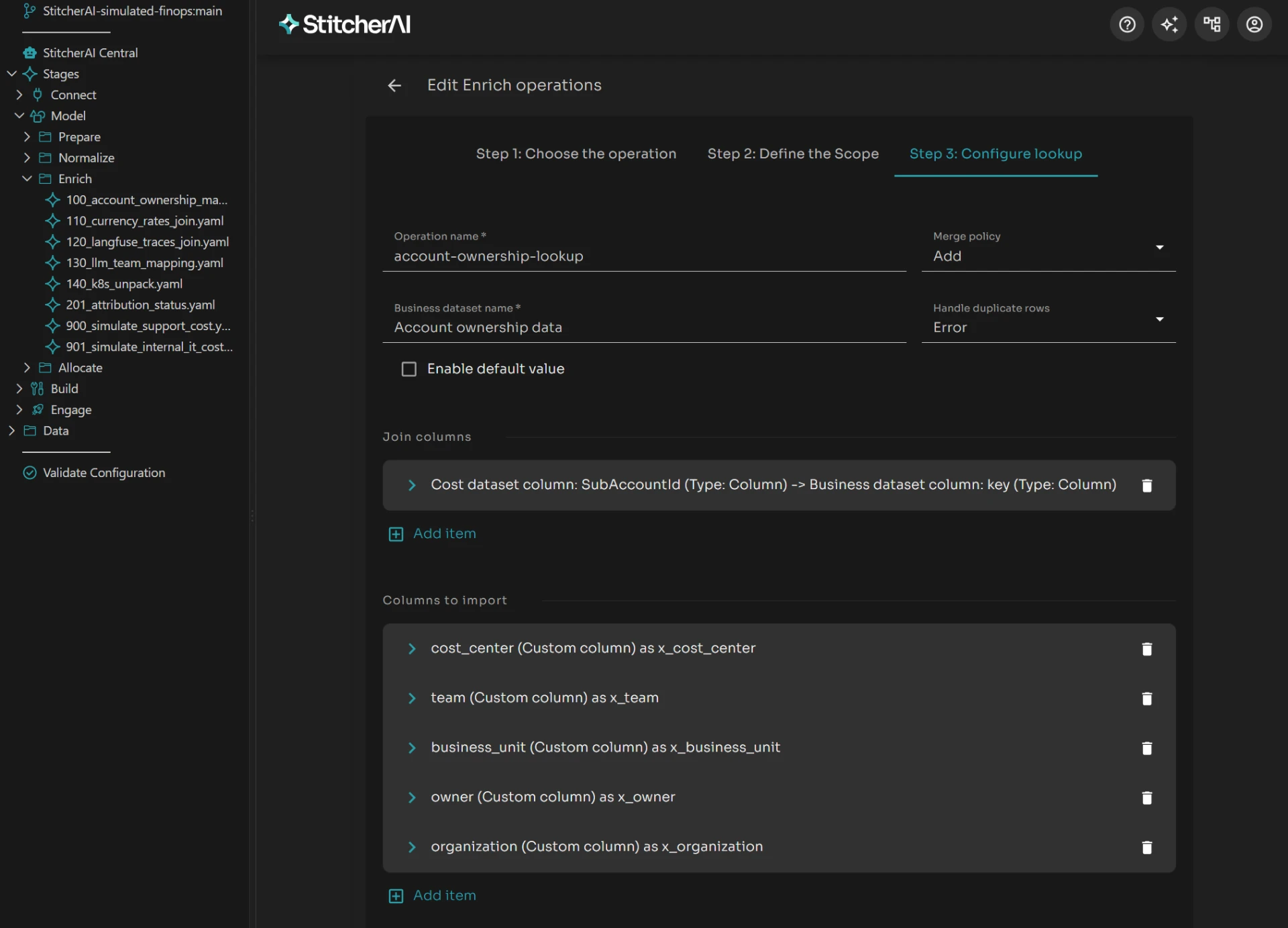
Lookups carry most of the estate with the least upkeep; mappings handle the finer-grained cases the records miss. Because both run against a single FOCUS-normalized dataset, a rule is written once and applies across the whole estate. And because the business data lives in the model, attribution updates as that data does: when ownership changes, the model changes with it, rather than waiting on someone to hand-edit a rule.
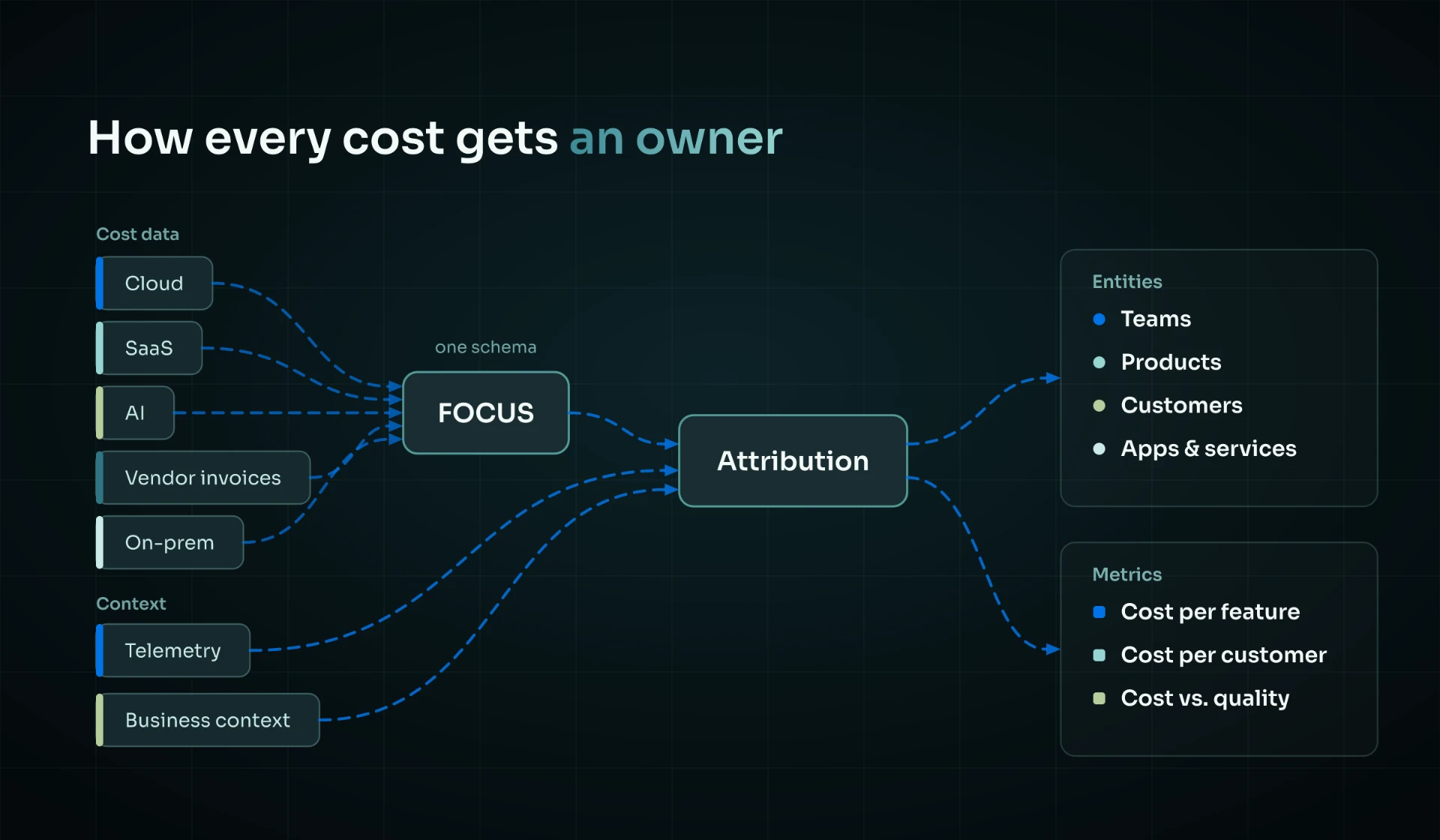
The two also work together. A cost can be resolved to a raw owner from its own attributes, then enriched with the business's own definitions into something a stakeholder actually recognizes. The result is cost attributed the way the organization is structured, consistently, across every source in the estate.
Attributing agentic AI cost
AI is where attribution is hardest, and where getting it right matters most. A provider bill records tokens consumed and models called, with no link to the team, feature, or customer that drove them. Neither the cost data nor a business ownership register can close that gap on its own, because the missing information is usage: which workload made the calls, on whose behalf, for what.
That usage lives in telemetry. StitcherAI ingests that telemetry into the model alongside cost and business context, so AI spend can be attributed the same way every other cost is, to the part of the business responsible for it. The traces that show which application, agent, feature, or tenant generated the consumption become the bridge between an aggregated inference bill and a real owner.
Cost is only half the picture
AI needs several kinds of business context, and attribution is how each one gets attached to cost. Deeper usage context, which features, which tenants, which use cases drove the spend, comes from telemetry. Other context can be attributed the same way, including the quality of the responses the spend produced.
A cost per workload tells you what an AI feature costs. A quality measure attributed to that same workload tells you whether a cheaper model would deliver comparable results, or whether the saving comes at the expense of the outcome, which is what turns cost data into a real view of business value.
That quality signal, evaluation scores, accuracy measures, human ratings, whatever an organization uses to judge its AI, is just another dataset attributed alongside the cost. Bring it into the model and cost and quality can be read together instead of guessed at separately.
This is what turns AI from the least accountable line in the estate into one managed like any other. Its cost resolves to the feature and customer that drove it, and its value can be weighed in the same place. That is the level at which anyone can actually judge whether the spend is worth it.
Bill to business
Attribution is the first move from a bill you can see to a number you can act on. Get it right and every cost in the estate carries an owner, expressed in the terms the business runs on, and everything downstream, allocation, unit economics, forecasting, the case for what to scale and what to stop, has a foundation it can stand on. Get it wrong and none of those numbers can be trusted, however good the tooling above them looks.
This is where StitcherAI starts: cost attributed the way your organization is actually built. See what that looks like against your own estate.